

Wood veneer vs solid wood: which is better for furniture?
By Gallery Elmir, Tripoli, Lebanon · Updated
Natural wood veneer is a thin sheet of real wood, sliced from a log and pressed onto a stable core such as blockboard. On large surfaces like wardrobe doors, headboards and desk tops, veneer on a stable core stays flatter than a wide panel of solid wood while still showing real grain. Solid wood is the better choice for frames, legs and edges that need strength and may be sanded and repaired. Laminate and melamine look like wood but are printed decor, not wood. Gallery Elmir finishes its bedroom sets and office furniture in natural veneer, in the species and colour each customer chooses.
What natural wood veneer is
Veneer is sliced from a log in sheets usually well under a millimetre thick. The way the log is cut sets the pattern: rotary cutting peels a wide sheet with a bold, wavy figure; crown or flat cutting gives the familiar arched cathedral grain; quarter cutting gives straight, even stripes. Consecutive sheets can be laid as mirror images, called book matching, so the grain flows across a pair of doors.
Why veneer is used on wardrobes, headboards and desks
Wide solid boards move with humidity and can cup, twist or split. A veneer pressed onto a stable core such as blockboard does not, so tall doors close cleanly for years. Veneer also lets every piece in a room share the same grain and colour, uses fine species efficiently, and keeps large pieces lighter than solid wood would.
Where solid wood is the better choice
Solid wood is the right material where strength and repairability matter most: chair and bed frames, legs, rails, edges and carved details. A solid surface can be sanded and refinished several times; a veneer can only be lightly sanded, so deep damage needs a specialist repair. Gallery Elmir uses solid beech for this kind of work, as explained in what our furniture is made of.
Natural veneer, artificial veneer, laminate and melamine
| Surface | What it is | Look | Repairs |
|---|---|---|---|
| Natural veneer | A thin slice of real wood | Real grain; no two pieces identical | Light sanding and refinishing by a specialist |
| Artificial (reconstituted) veneer | Real wood re-dyed and re-sliced into a uniform pattern | Very even, repeating grain | Similar to natural veneer |
| Laminate (HPL) | Layers of resin paper with a printed decor on top | Printed wood image; hard wearing | Cannot be sanded; chips are hard to hide |
| Melamine | Printed paper fused straight onto the board | Printed wood image; flat feel | Cannot be sanded; edges chip |
Popular veneer species
At Gallery Elmir the veneer species and colour are the customer's choice for each made-to-order bedroom set or office piece. Bring a photo of your floor or doors to the showroom in Tripoli to match tones.
- Oak (sindyan / balout): open, visible grain in light to mid tones; takes stains well and suits both modern and classic rooms.
- Walnut (jawz): dark brown with a rich figure; a classic choice for master bedrooms and executive offices.
- Ash: pale with a strong, straight grain, for light and contemporary rooms.
- Beech: pale and even, with a fine, quiet grain.
How to tell real veneer from laminate
- Look for repeats: a printed laminate repeats the same knot or streak at regular intervals; real veneer does not.
- Compare the doors: book-matched veneer mirrors from door to door, with small natural variations.
- Check the edges and the inside of doors and drawers for how the surface is finished.
- Ask directly: is the surface natural veneer, artificial veneer, laminate or melamine?
Caring for veneered furniture
- Dust with a soft, dry or slightly damp cloth; never soak the surface.
- Use coasters and wipe spills at once, especially near edges.
- Keep pieces out of strong direct sun, which changes the colour of any real wood over time.
- Avoid harsh solvents and abrasive pads, which damage the lacquer.
From the collection

Harlow Grey Bedroom Set
Grey padded headboard · Warm wood-tone storage
$3,300

Twin Bedroom Set
Two-bed layout · Coordinating wood-tone storage
$3,200
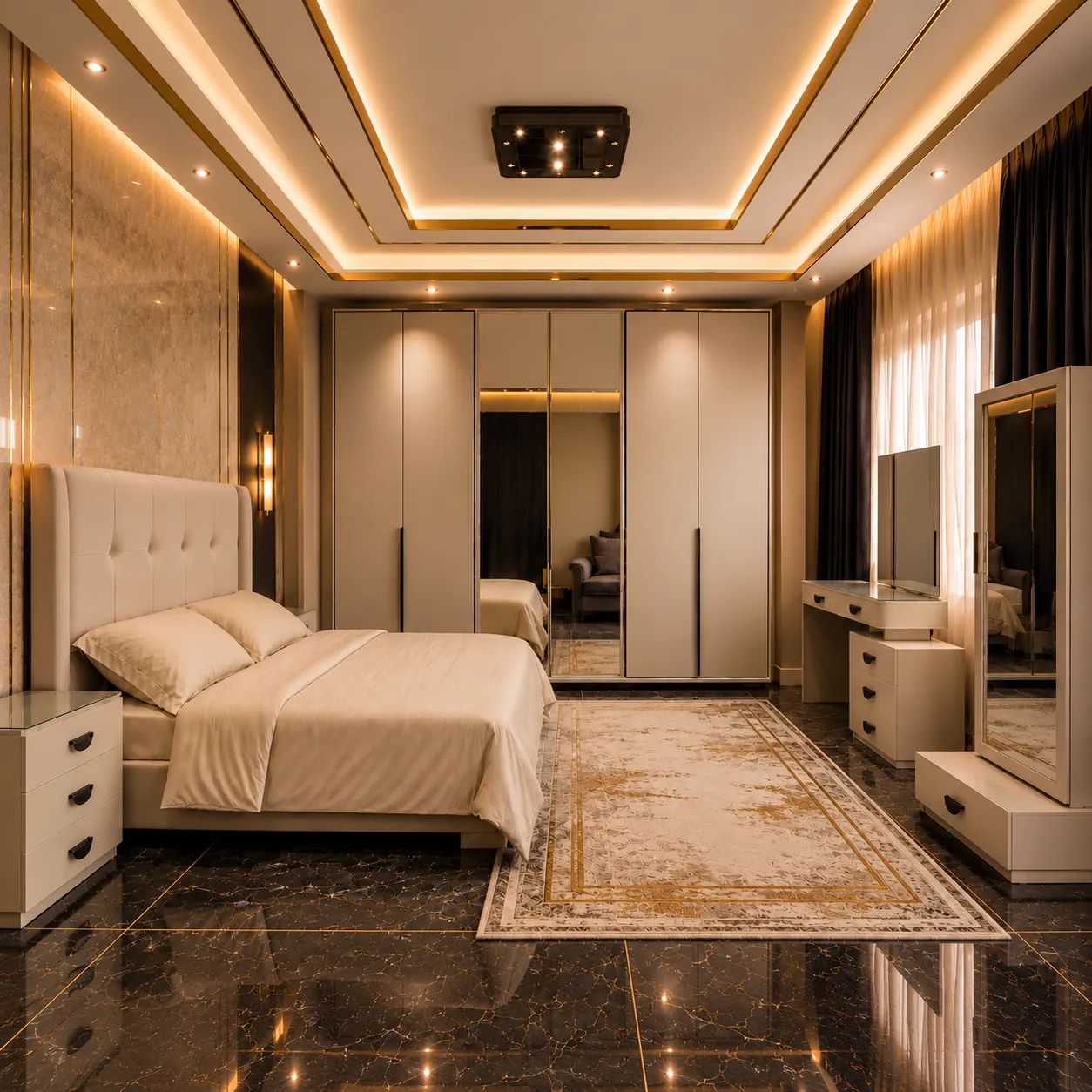
Alden Cream Bedroom Set
Cream finish · Upholstered headboard and mirrored storage
$3,300

Classic Dark Bedroom Set
Ornate headboard · Dark wood-tone furniture
$3,400
Questions and answers
Is veneer furniture real wood?
Natural veneer is real wood: a thin slice cut from a log and pressed onto a stable core. Laminate and melamine are not wood; they are printed decor papers.
Does wood veneer peel?
Well-pressed veneer on a stable core does not peel in normal use. Problems usually start where water stands on an edge for a long time, so wipe spills quickly.
Which veneer is better for a bedroom set, oak or walnut?
Both are durable, so it is a question of style. Oak is lighter with an open grain and suits modern rooms; walnut is dark and rich and suits a formal master bedroom.
Can I choose the veneer on a Gallery Elmir bedroom set?
Yes. Gallery Elmir finishes its made-to-order bedroom sets and office furniture in natural wood veneer, and the customer chooses the species and colour.
See the materials in person at our showroom in Zahrieh, Tripoli, Monday to Saturday, 9:00 AM to 7:00 PM. Plan your visit